When you use DPReview links to buy products, the site may earn a commission. Product photos: Mitchell Clark This week, Sony announced the a7 V, the latest enthusiast-class mirrorless camera to use a 'partially stacked' sensor to achieve the fast readout speeds required for high-speed bursts and video.
It's entering a market segment with stiff competition, both from other cameras using similar sensor technology and ones that achieve pretty similar performance even without it.
To see how it competes, we'll compare it to similarly positioned cameras – the Canon EOS R6 III, Panasonic S1II and Nikon Z6III – in a variety of categories. We'll largely leave out comparisons with the a7 IV for now, as we'll be discussing it in more depth in an upcoming article.
Price
As this segment of the market has become more capable (and as inflation and, in the US, tariffs have continued to raise costs), the price tags on the cameras have also risen. The a7 V is in the same ballpark as competitors like the Canon EOS R6 III and Nikon Z6III, though it's the most expensive among the three. And not just because it's the most recent release.
Sony a7 V
Canon EOS R6 III
Panasonic S1II
Nikon Z6III
MSRP (US/UK)
$2900 /
$2800 /
$3200 /
$2700 /
It is, however, still a fair bit cheaper than the Panasonic S1II, at least in the US. In the UK and Europe, the prices for all four cameras are more evenly matched, with the Z6III being the only one that really stands out as considerably cheaper.
Resolution and speed
Like its predecessor, the a7 V has a 33MP sensor, which provides 16% more linear resolution than the 24MP models used by Panasonic and Nikon. Sony has joined those companies in using a "partially stacked" sensor, though, which uses more complex circuitry to increase readout speeds.
Sony a7 V
Canon EOS R6 III
Panasonic S1II
Nikon Z6III
Resolution
33MP
33MP
24MP
24MP
Stills rolling shutter rate (e-shutter)
Canon's sensor in the EOS R6 III provides a similar level of resolution and, at first glance, speed, despite the company using an FSI design. However, it's worth noting that in e-shutter mode, it drops to a 12-bit readout rather than a 14-bit one, which is a concession the other models don't have to make in most circumstances.
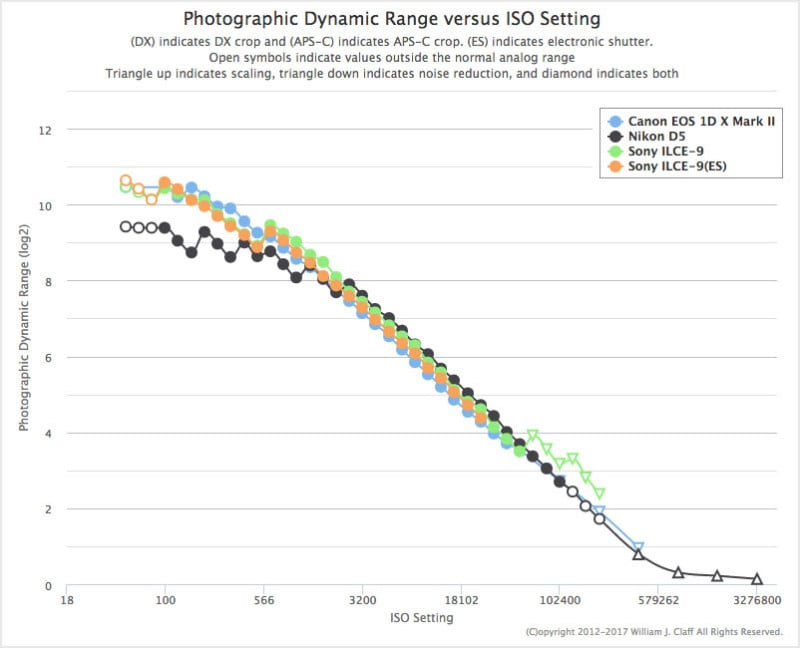
It's hard to say whether that difference will end up being mostly academic, though. The Canon's lower bitrate readout hurts dynamic range, resulting in more noise in the deepest shadows. But while the specs make it seem like the a7 V will maintain more dynamic range during continuous shooting, we've also seen that partially stacked sensors can have less dynamic range in their e-shutter modes, which may make the difference in bit depth less consequential in practice.
The issue is most prevalent on the Z6III, as it happens in all of its shooting modes, whereas the Panasonic S1II can achieve better dynamic range when using its mechanical shutter. However, it can't maintain that performance while using its electronic shutter because of the impact it would have on its rolling shutter rates. Sony says the a7 V will also be able to get great dynamic range when using its mechanical shutter, but early reports indicate that its DR drops in e-shutter mode, suggesting there'll be a price to pay there, too.
Viewfinder and screen
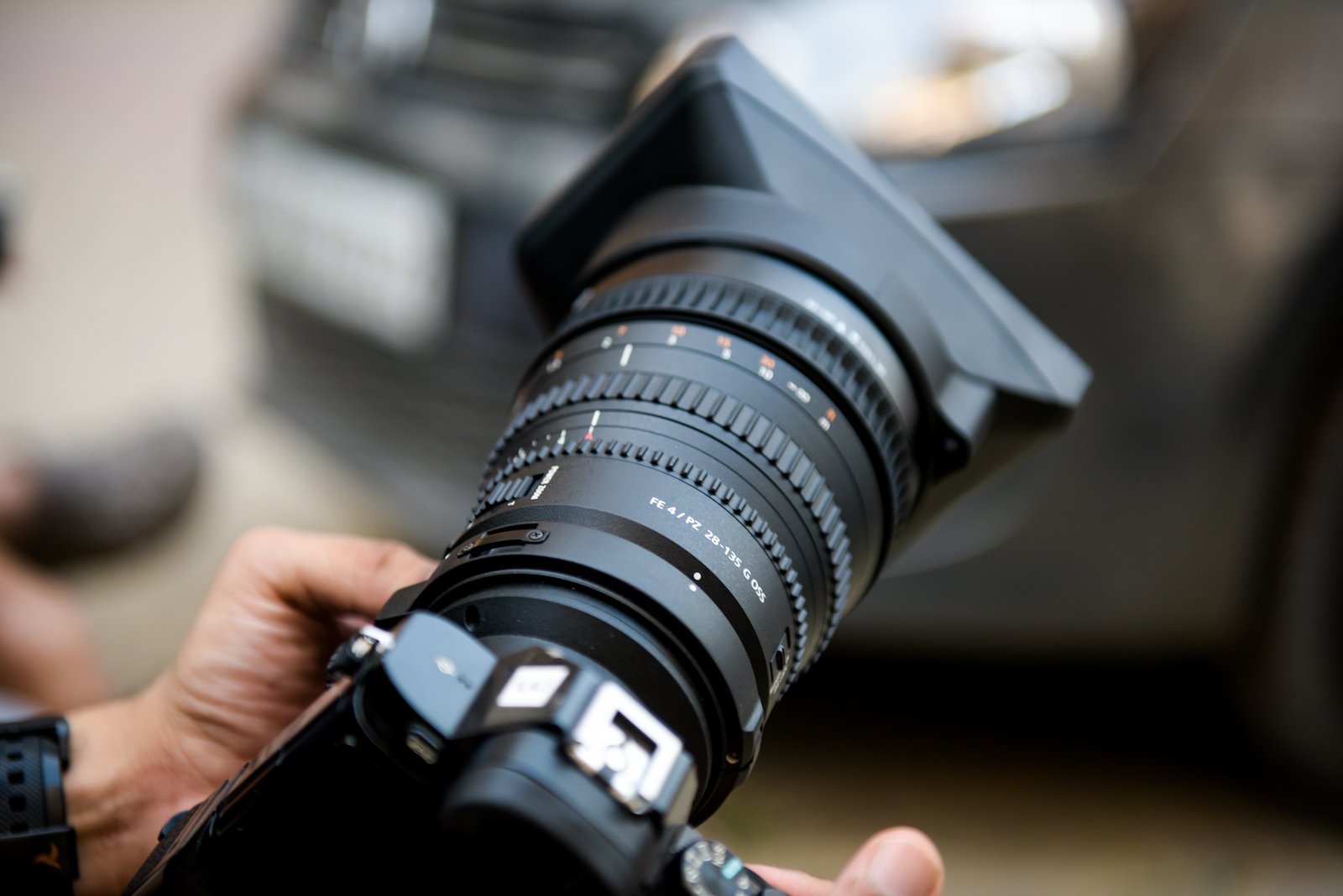
The tilting/articulating mechanism on the a7 V and Panasonic S1II also gives you plenty of clearance for microphone, headphone and HDMI plugs when shooting video.
The a7 V hasn't made any big strides with its viewfinder, which, like the Canon's, is starting to feel a little dated, but its rear display is among the best in class. Not only is it larger and higher resolution than the ones Canon and Panasonic use, but it features a mechanism that lets you tilt it in line with the sensor, while also being able to fully articulate it for shooting at odd angles, or taking video of yourself, all without fouling the ports on the side of the camera.
Sony a7 V
Canon EOS R6 III
Panasonic S1II
Nikon Z6III
Viewfinder res/magnification/eyepoint
3. 69M dot
0. 78x
23mm
3. 69M dot
0. 76x
23mm
5. 76M dot
0. 78x
21mm
5. 76M dot
0. 8x
21mm
Rear screen
3. 2"
2. 1M dot
Tilt + Fully articulating
3. 0"
1. 62M dot
Fully articulating
3. 0"
1. 84M dot
Tilt + Fully articulating
3. 2"
2. 1M dot
Fully-articulating
All four companies give you the option to run the EVFs at a very responsive 120fps. Panasonic and Nikon's are higher resolution, which can be nice when reviewing photos, and the Z6III's can reach up to 4000 nits peak brightness, making it more visible even in harsh sunlight. Sony advertises that the a7 V has "blackout-free" shooting, though we'll have to test whether it truly continues to live refresh the preview as you're pressing the shutter, or if it's achieving the blackout-free effect by displaying the previously shot frame, as competitors like the Z6III and EOS R6 III do.
Autofocus
The a7 V gains Sony's latest autofocus system, which we've found to be one of the most capable around when it comes to tracking and overall reliability. It offers a wide array of autofocus selection points, for both tracking and non-tracking, and like with Canon and Sony, its general tracking system works in conjunction with its subject recognition one. If the camera recognizes a subject under or around your selection point, it'll track it using the dedicated algorithms for it; otherwise, it'll attempt to track whatever is there. Panasonic takes a different approach, requiring you to switch between generic tracking and subject recognition.
Speaking of, like all the cameras in this comparison, the a7 V can recognize several subject types: humans, animals, birds, vehicles and planes, and is alone in offering a dedicated insect mode. It also has part recognition, narrowing in on a person, animal, or bird's eye, or the nose of an airplane.
Sony also offers an "Auto" mode, like Nikon and Canon, and allows you to select which subject types you'd like to be included in it.
Continuous shooting and pre-capture
The a7 V can shoot at a very respectable 30fps with its electronic shutter and, like most of its peers, has an option for pre-burst capture, where the camera will start saving images to the buffer when you initiate autofocus, and then write them to the card once you've fully pressed the shutter button, which can help you capture a moment even if you're a bit late to the draw. Its framerates aren't quite as high as those from Canon and Panasonic (though again, see the discussion about the EOS R6 III's 12-bit readout in burst rate, and the Sony's potentially reduced DR despite its 14-bit readout), but they should still be sufficient for all but the quickest action.
Sony a7 V
Canon EOS R6 III
Panasonic S1II
Nikon Z6III
Maximum burst rate
10fps mech.
30fps e-shutter
12fps mech.
40fps e-shutter (12-bit)
10fps mech.
70fps e-shutter (12 bit)
60fps e-shutter (14 bit)
14fps mech.
20fps e-shutter
60fps JPEG-only
Pre-Capture
Up to 1 sec
Up to 1 sec
Up to 1. 5 sec
Yes (JPEG only)
Sony's edge is in its pre-capture configurability. Panasonic only lets you use pre-capture with its "SH" burst rates (so 30, 60, or 70fps), and Canon is even more restrictive, with its pre-burst capture setting only usable with its 40fps mode. Sony, meanwhile, lets you use it in each of its e-shutter burst modes, and lets you fine-tune how far back you want it to save, from a mere 0. 03 seconds (1 frame at 30fps) before you fully pressed the shutter to a whole second. Both options make it easier to avoid having to sort through dozens of pictures taken before the most important moment.
Battery
When it comes to battery life ratings, Sony is clearly the standout. The a7 V is rated to get over double the number of shots using the EVF compared to the EOS R6 and S1II, and has a 75% lead over the Nikon Z6III. We're looking forward to testing it more to see if it has to make compromises, such as dimming the screen after a very short period of inactivity, to get such a high rating, but we're used to Sony squeezing a lot from its large NP-FZ100 batteries.
Sony a7 V
Canon EOS R6 III
Panasonic S1II
Nikon Z6III
Battery life EVF / LCD
630 / 750
270 / 510
310 / 350
360 / 390
While the CIPA ratings aren't typically reflective of the literal number of shots you'll get out of a charge, they work as an indicator of what kind of experience the camera will provide, and it seems like the a7 V will let you go a long time without having to use a charger. . .
Ports, storage and connectivity
The a7 V is the only camera in this comparison to lack a dedicated remote trigger terminal. . . though theoretically you could use the second USB-C socket as one, provided Sony updates its remote to use the more modern cable type, instead of the microUSB / Multi terminal one that this replaces.
. . . which is funny, since it has double the number of charging ports as its competitors. The a7 V features two USB-C ports, one mainly meant for data, which supports speeds up to 10Gbps, and one for power delivery, which tops out at 480Mbps. This setup will let you charge the camera while tethering, without draining your computer's battery, or let you plug in potential USB-C accessories while also charging the camera or transferring data from it.
Canon, Panasonic and Nikon's cameras each only have a single USB-C port; the EOS R6 III and S1II's at least run at the same 10Gbps, while the Z6III's is 5Gbps.
The a7 V is also the first mirrorless camera we've seen to support the Wi-Fi 6E standard, which should let you transfer images off your camera wirelessly using the faster (and less crowded) 6Ghz spectrum, provided the standard is certified in your country. The rest of the cameras can only use the 2. 4 and 5Ghz bands.
Outside of these two standout specs, the a7 V has the same set of ports that's become standard on this class of camera: 3. 5mm jacks for microphones and headphones, and a full-size HDMI port.
HDR shooting
Like the rest of its competitors, the Sony a7 V has the option of shooting 10-bit HEIF files encoded with a high dynamic range tone curve, which will look more vibrant and capable of more realistic highlights when shown on a display capable of HDR playback*. However, you can't capture HDR output files and Raws at the same time on the Sony; it's one or the other. Neither Canon, Nikon, nor Panasonic require this same trade-off, so you don't have to give up editing flexibility for straight-out-of-camera HDR.
* - which may be easier said than done, as HEIF files don't enjoy nearly as broad compatibility as JPEGs do.
Video - resolution, framerates and workflow
The list of video modes in the a7 V is spartan compared to the ones on other cameras, but the ones it has are well-executed.
The Sony a7 V can record full-width UHD 4K footage oversampled from 7K capture at up to 60p, and can do 120fps at 4K with a 1. 5x crop. Unlike its competitors, there's no option to natively record the higher-resolution capture, nor is there an open gate recording mode or internal Raw recording (or, indeed, external Raw recording via HDMI), if your shooting requires these arguably niche features.
What will likely matter to everyone shooting video is overheating performance. The a7 V has an apparently very impressive heatsink, with Sony saying you can expect to be able to record 4K/60 footage for up to 90 minutes, while Canon only quotes 23 minutes for the EOS R6 III (though you can get more out of it if you switch out of the oversampled mode). Panasonic promises essentially no limit for 4K/60 recording on the S1II following its most recent firmware update, though that camera has an internal fan to keep things cool, while the Sony does not.
Sony a7 V
Canon EOS R6 III
Panasonic S1II
Nikon Z6III
Video resolutions
UHD 4K/60 (full-width, oversampled)
UHD 4K/120 (1. 5x crop)
1080/240
7K DCI/60 (Raw)
7K/30 open-gate
4K/120 (full-width)
1080p/180 (full-width)
6K/30 3:2 (Raw / open gate)
5. 7K/60 DCI (Raw)
5. 9K/60 (16:9)
DCI 4K/120 w/ 1. 17x crop
6K/60 (Raw)
5. 4K/60 (full-width)
UHD 4K/60 (full-width)
UHD 4K/120 (1. 5x crop)
Uncompressed video
No
C-Raw
Over HDMI
ProRes Raw
Over HDMI
N-Raw
ProRes Raw
Video assist tools
Log view assist
Custom LUTs
Auto Framing
Framing
Stabilizer
False color overlay
Waveform
Log view assist
False color
Waveform
Vectorscope
Anamorphic desqueeze
Shutter angle
Log view assist
Custom LUT recording
Waveform
Log view assist
Shutter angle
The a7 V lacks the variety of assistance tools that some of its competitors have; shutter angle and waveform monitoring feel like particularly notable omissions, as they make it easier to avoid mistakes in fast-paced shooting environments.
A feature Sony includes that others don't is its "AI Auto Framing" mode, which lets you set up the camera on a tripod and have it crop in on you or another recognized subject, following it around the scene. This can automatically give you a more dynamic shot where you would've had a static one if you're shooting without a camera operator. There are also several controls for it, letting you choose how tight you want it to punch in and how quickly you want it to follow you.
Video - rolling shutter
Given the a7 V's fast sensor, it's no surprise that its rolling shutter is very well-controlled, despite the fact that its 4K modes are derived from higher-resolution capture.
Sony a7 V
Canon EOS R6 III
Panasonic S1II
Nikon Z6III
Rolling shutter rate (4K/24)
We consider rates below 15ms to be excellent, so we wouldn't expect to see jello-like artifacts in anything but the whipiest of pans, or on the fastest of moving subjects, from any of these cameras. As such, it's unlikely the differences between these cameras will matter for almost all shooting.
The extras
We wouldn't have minded a customizable front-plate button or two.
While Sony has tweaked the ergonomics of the a7 V, those of us at DPReview who've had the chance to hold it still don't find it to be quite as comfortable as the other cameras in this comparison or Sony's high-end models like the a1 II or a9 III. And while you won't find yourself starved for control points, most of the other cameras in this category do have an extra customizable button or two compared to the a7 V.
Sony has implemented a multi-shot high-resolution mode in the a7 V, which promises to capture more detail with less noise. However, as with the similar mode on the Z6III, you have to combine the photos after the fact using desktop software. The Panasonic S1II has a similar feature, but it works both handheld and with a tripod, and is combined in-camera, making it much more versatile. None of these systems will work that well with moving subjects – Sony's and Panasonic's have some level of motion correction, but you lose the benefits in areas of movement – but with the S1II's, it's easier to just try it to see if it works; if not, you'll still capture the image, just without the bump in image quality. Canon doesn't have a comparable mode on the EOS R6 III.
Summary
It's clear that the a7 V is a much better competitor to the latest crop of enthusiast cameras than its predecessor was, and is a strong hybrid offering. And while it's not the most versatile video camera out there, for those without very specific requirements, it looks to be a hugely competent all-rounder, and one that can last all day on a single charge at that. It'd be hard to pick the wrong camera in this category (or, by the same token, to declare one as head and shoulders above the rest).
We'll have to put it through more testing to see if it delivers on its promises of excellent image quality despite its speed, and to see if its autofocus meets our expectations for what Sony is capable of. If it does, it'll be a very strong contender in the market.
. dpreview.com2025-12-4 17:00